
Stay informed with expert analysis, updates, and
practical guidance on Canada’s
immigration system and policies.
Our blog is designed to simplify complex topics and provide accurate, experience-based insights into temporary and permanent residence pathways.

There is a moment in every removal case where the options narrow to a single point. The refugee claim has been heard and rejected. The appeal to the Refugee Appeal Division has failed. The Federal Court declined leave for judicial review. The humanitarian application is pending but offers no guaranteed stay. And then a letter arrives from the Canada Border Services Agency not a removal date, but something else. A notification that you may be eligible to apply for a Pre-Removal Risk Assessment.
For many people facing deportation from Canada, this notification is the last formal opportunity the legal system will offer. It is not a second refugee hearing. It is not an appeal. It is a narrow, paper-based process designed to answer one question: if Canada removes this person today, will they face persecution, torture, or death?
Understanding what the PRRA actually is and what it is not is the essential starting point for anyone who finds themselves holding that notification letter.
Canada’s commitment to the principle of non-refoulement sits at the heart of its entire refugee and protection framework. Non-refoulement a concept rooted in the 1951 Refugee Convention, means that no country may return a person to a territory where they face serious harm. Canada has enshrined this obligation in the Immigration and Refugee Protection Act, and the PRRA is the mechanism through which that obligation is fulfilled even after all other protection pathways have been exhausted.
This matters because removal orders are not inherently wrong or unjust a person can have their refugee claim fairly heard and fairly refused, and still face a genuine risk that has emerged or escalated since that hearing. Country conditions change. Political situations deteriorate overnight. A person’s profile can shift; someone who was once an anonymous dissenter can become, after years of public advocacy in Canada, a known target in their country of origin. The PRRA exists to catch these situations. It is not a system designed to relitigate settled cases. It is a safety valve for genuine new risks.
That distinction between relitigating old claims and presenting genuinely new evidence defines almost everything about how a PRRA application succeeds or fails.
The first thing many people misunderstand about the PRRA is that you cannot apply for one on your own initiative. There is no form you can file independently, no portal you can access to request the process. The PRRA is triggered by CBSA when enforcement of a removal order is imminent. A CBSA officer determines whether you are eligible and, if so, provides you with the application kit.
This means that your eligibility and the timing of your PRRA is largely outside your control. It is initiated by the agency that is trying to remove you, which creates an inherent tension that applicants need to understand. The same agency managing your departure is also the one deciding whether you qualify for a last-chance protection review.
Not everyone subject to a removal order will receive a PRRA notification. People who have been recognized as Convention refugees elsewhere in the world are not eligible. Those under extradition orders are excluded. And critically, people who fall under the Safe Third Country Agreement specifically those who entered Canada from the United States at a land border face restrictions that have been the subject of significant litigation and policy debate.
For those who previously had refugee claims heard by the Immigration and Refugee Board, there is also the 12-month bar: a mandatory waiting period before PRRA eligibility attaches. This bar exists because the Canadian system does not want the PRRA to function as an automatic appeal mechanism. If you had a full IRB hearing within the past year, the system presumes that your protection needs were assessed adequately. The bar can be lifted in specific circumstances when country conditions have deteriorated rapidly and the Minister has designated certain nationalities as exempt but it applies to the vast majority of failed claimants.


Once you receive a PRRA notification, the clock begins immediately. The timelines are brutally short. You typically have 15 days to file the application form, followed by a further period to submit your written submissions and supporting evidence. In total, from notification to complete file submission, applicants often have roughly 30 days sometimes less.
In a process with so much riding on it, 30 days is almost nothing.
The PRRA is decided almost entirely on paper. Unlike an IRB hearing, where you sit before a Member, testify about your experiences, respond to questions, and have your demeanor and credibility assessed in real time, the PRRA officer reviews a written file. In rare cases involving significant credibility issues, an oral hearing may be convened, but this is the exception rather than the norm. For the overwhelming majority of applicants, what they submit on paper is what decides their fate.
This has profound implications for how a PRRA application must be prepared. A compelling oral testimony at an IRB hearing can overcome weak documentation. A PRRA officer has no such testimony to draw on. Every gap in the written evidence, every unaddressed inconsistency, every country condition argument left implicit rather than explicit all of it works against the applicant.
The written submissions in a PRRA application need to accomplish several things simultaneously. They must clearly identify what new risks exist that were not before the RPD, explain why those risks are genuinely new rather than extensions of previously assessed claims, anchor the personal risk in objective country condition evidence, address the possibility of internal relocation within the home country, and explain why state protection is unavailable or inadequate.
That is a substantial analytical and evidentiary task for a process with a 30-day timeline.
For applicants who previously had an IRB hearing, the most significant legal constraint on the PRRA is the requirement that evidence be new. An IRCC officer assessing a PRRA for a failed refugee claimant is not permitted to re-weigh evidence that was already before the RPD. They are looking specifically for evidence that arose after the RPD decision or that was not reasonably available at the time of the hearing.
This rule trips up a significant number of PRRA applicants. They approach the process as though it is a second hearing, gather the same type of evidence they used before, and submit it believing that a different officer might reach a different conclusion. That is not how the process works. A PRRA officer reviewing evidence that was available at the time of the RPD hearing must set it aside, regardless of how compelling it is.
What qualifies as genuinely new? A threat letter received after the RPD hearing. Evidence of harm that befell a family member who remained in the country after the RPD decision. A news report documenting a crackdown on a political or religious group that postdates the hearing. A change in the applicant’s personal profile for example, their well-publicized advocacy in Canada has come to the attention of authorities in their home country. An updated country condition report documenting a significant deterioration in the human rights situation since the hearing date.
The key in every case is the temporal link: when did this evidence come into existence, and why was it not available or reasonably discoverable at the time of the RPD hearing? A PRRA application that cannot answer those questions clearly is unlikely to succeed.
Not all PRRA applications are assessed on the same grounds. For applicants who are being removed specifically because of serious criminality certain convictions carrying potential sentences of 10 years or more, with actual sentences of two or more years the scope of the PRRA is significantly narrowed.
In these restricted PRRAs, the officer cannot assess whether the applicant faces a risk of persecution. Only the narrower grounds of torture and risk of cruel and unusual treatment are available. This distinction matters enormously in practice, because persecution with its broader definition covering race, religion, nationality, political opinion, and membership in a particular social group is the ground on which most successful protection claims are based. Restricted PRRA applicants must demonstrate something more severe and direct.
This is one area where the intersection of criminal law and immigration law creates some of the most complex cases in the entire immigration system. A person can be simultaneously a genuine victim of persecution and someone who committed serious crimes in Canada. The PRRA does not ignore the criminality it shapes the entire framework of the assessment.
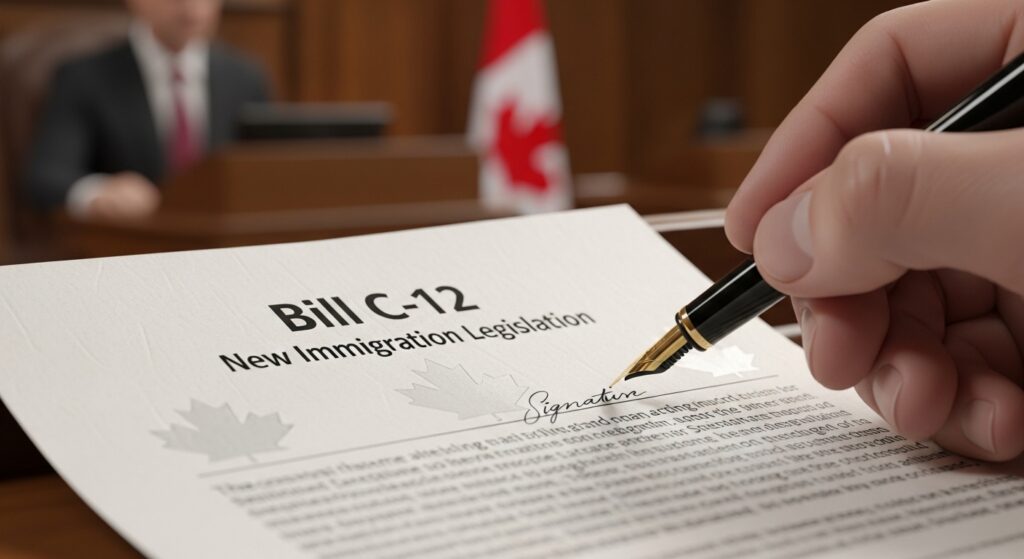

The landscape of the PRRA shifted dramatically in early 2026 with the passage of Bill C-12, the Strengthening Canada’s Immigration System and Borders Act. Two specific provisions in this legislation have had immediate and significant consequences for tens of thousands of asylum seekers.
The first is what has come to be called the one-year rule: individuals who entered Canada after June 2020 and waited more than a year after entry before filing their asylum claim will not have their claim referred to the IRB. Instead, PRRA becomes their first and only formal protection assessment.
The second is the 14-day rule: individuals who crossed the Canada-U.S. land border between ports of entry and waited more than 14 days to file a claim are similarly diverted away from the IRB and into PRRA.
The practical consequence of these rules is that thousands of people who, under the previous system, would have received a full oral hearing before an independent IRB Member are now receiving a paper-based PRRA assessment as their sole protection review. The implications are serious. IRB approval rates hover around 55-65%. PRRA approval rates for failed claimants historically sit in the low single digits. Even for first-time PRRA applicants under the new rules who can submit a full evidentiary record and face no new evidence restriction the expected approval rate is roughly 30-33%.
The gap between those numbers is the subject of significant criticism from refugee law practitioners, human rights organizations, and legal academics. The concerns center on the absence of oral hearings, the lack of an independent decision-maker in the PRRA process, and the elimination of the right to appeal to the Refugee Appeal Division for those diverted from the IRB stream. Whether the courts will ultimately find these provisions consistent with Canada’s constitutional and international obligations remains an active legal question.
For applicants caught by these rules, the stakes of a carefully prepared PRRA application are, if anything, higher than ever.
Given the approval rates, it is tempting to view the PRRA as a formality a step in the removal process that almost never succeeds. That view is both statistically understandable and practically dangerous. Cases that succeed do so for identifiable reasons, and understanding those reasons is the foundation of a credible application strategy.
Successful PRRA applications generally share several characteristics. The personal risk is specific and individualized. Generalized country conditions, while important as background, do not alone establish a personalized risk. A successful applicant can explain precisely why they, specifically, face a danger that the general population of their home country does not and they can link that explanation to objective evidence.
The country condition evidence is current and credible. Human rights reports from Amnesty International, Human Rights Watch, UNHCR, the U.S. State Department, and reputable academic sources carry significant weight. Evidence from lesser-known sources should be accompanied by a clear explanation of the source’s credibility and methodology.
The internal relocation question is addressed head-on. PRRA officers are required to consider whether an applicant could safely relocate within their home country rather than face the specific risk they have identified. A strong application anticipates this question and provides evidence explaining why relocation is not a viable option whether because the agent of persecution has reach throughout the country, because the applicant’s profile makes them identifiable anywhere in the country, or because the conditions throughout the country make safe relocation impossible.
The legal submissions are precise. The PRRA officer is assessing whether the grounds under IRPA are met persecution, torture, risk to life, cruel and unusual treatment. A strong application maps the evidence directly to the legal standard rather than leaving the connection implicit.
A positive PRRA decision grants protected person status. This is not just a stay of removal it is a formal recognition of protection, carrying rights equivalent in many ways to convention refugee status, including eligibility to apply for permanent residence. The removal order is cancelled.
A negative PRRA decision resumes the removal process. The only remaining legal recourse in Canada is an application for leave and judicial review at the Federal Court. This is not an appeal the Court is not assessing whether it would have reached a different conclusion on the evidence. It is reviewing whether the officer’s decision was reasonable and whether the applicant received procedural fairness. Leave is granted in roughly one in five applications. If leave is denied, that is the final decision of the Canadian legal system on the matter.
Applicants should also be aware that a humanitarian and compassionate application can generally be submitted simultaneously with or alongside a PRRA, and that H&C grounds which include establishment in Canada, best interests of any Canadian children, and hardship are assessed on a separate and broader basis than the PRRA’s risk-focused framework.
The PRRA is described, accurately, as a last chance. But that framing can obscure something important: it is a real chance. The process exists precisely because Canada acknowledges that its immigration system is not infallible, that country conditions change, and that no removal should proceed without a final check on the risk the person faces.
If you have received a PRRA notification, the single most important thing you can do in the next 24 hours is contact a qualified immigration lawyer or Regulated Canadian Immigration Consultant authorized to practice before the IRB. Not next week. Not after you have thought about it. The deadlines in a PRRA process are among the shortest in the entire immigration system, and missing them does not result in delays it results in removal.
The door is open. The question is whether you can build, quickly and precisely, the case that keeps it open long enough to matter.
A negative PRRA decision resumes the removal process. The only remaining legal recourse in Canada is an application for leave and judicial review at the Federal Court. This is not an appeal the Court is not assessing whether it would have reached a different conclusion on the evidence. It is reviewing whether the officer’s decision was reasonable and whether the applicant received procedural fairness. Leave is granted in roughly one in five applications. If leave is denied, that is the final decision of the Canadian legal system on the matter.
Applicants should also be aware that a humanitarian and compassionate application can generally be submitted simultaneously with or alongside a PRRA, and that H&C grounds which include establishment in Canada, best interests of any Canadian children, and hardship are assessed on a separate and broader basis than the PRRA’s risk-focused framework.



Regulated Canadian Immigration Consultant
“The way to achieve your own success is to be willing to help somebody else get it first.”